
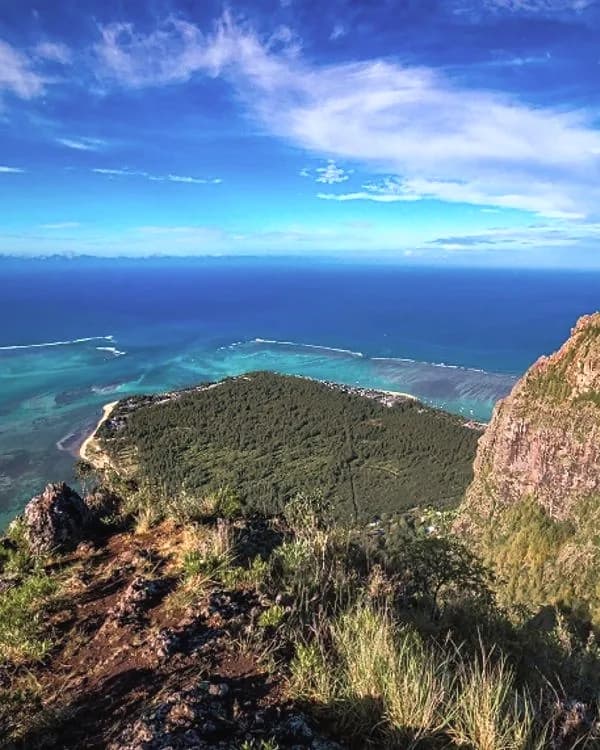
A Mountain And Marine Landscape
Look at Le Morne as a whole landscape. The mountain rises beside the coast, lagoon and reef, bringing several different habitats into one view. A visit can help you notice those differences, from the vegetation on the slopes to the water around the peninsula.
The mountain and coast also carry the history of the people who lived here. Nature and heritage meet in the same places, which is one reason to take your time and give the landscape more than a quick photograph.
Endemic And Indigenous Plants
Two words are useful when reading about Le Morne’s plants. Indigenous plants occur naturally in a region. Endemic plants are native to a particular place and found naturally nowhere else. The terms describe different relationships with a place; they are not interchangeable.
One plant closely associated with Le Morne is the Boucle d’Oreille, Mauritius’s national flower, described in the heritage guide as Trochetia boutoniana. Its red flowers hang like little bells. Another distinctive plant is Helichrysum mauritianum, known as L’Immortelle du Morne. These names give you a starting point for learning about the mountain’s rare flora.
Le Morne supports both endemic and indigenous vegetation, including rare plants. You don’t need to know every species to appreciate it. Look at the leaves, flowers and growth around the path, and leave what you find in place. If you’re curious about a plant, a photograph is a good way to keep the question for later.
Stay on the designated trail while looking. Leaving the path for a closer photograph can damage the very plants you came to see. Picking flowers, collecting plants or marking trees also harms a protected landscape.
What Hikers Should Do
A little care makes a difference. Keep your feet on the path, leave plants and animals undisturbed, and carry your litter out with you. Avoid pulling on branches as you walk, and give wildlife space when taking photographs.
Use the toilets at the trailhead where available before setting off. Leave rocks and any objects you come across in place, especially anything that could be part of the site’s archaeological heritage.
Choose a pace that lets you notice your surroundings. A short walk with time to look can be more satisfying than hurrying between viewpoints. Check the current trail access before planning your visit, and enjoy the parts of the mountain that are open.
Frequently Asked Questions
Why is biodiversity important at Le Morne?
Le Morne has sensitive habitats and endemic and indigenous plants, including rare species. Protecting them keeps the mountain’s natural life and the wider cultural landscape intact.
Can I collect plants, rocks, or objects?
Please leave them where they are. Take photographs instead of collecting plants or rocks, and leave archaeological objects untouched. Keeping things in place protects both habitats and the history of the site.
Plan a respectful visit
Explore the coast and nearby places at a comfortable pace, with time to enjoy the landscape around the mountain.