
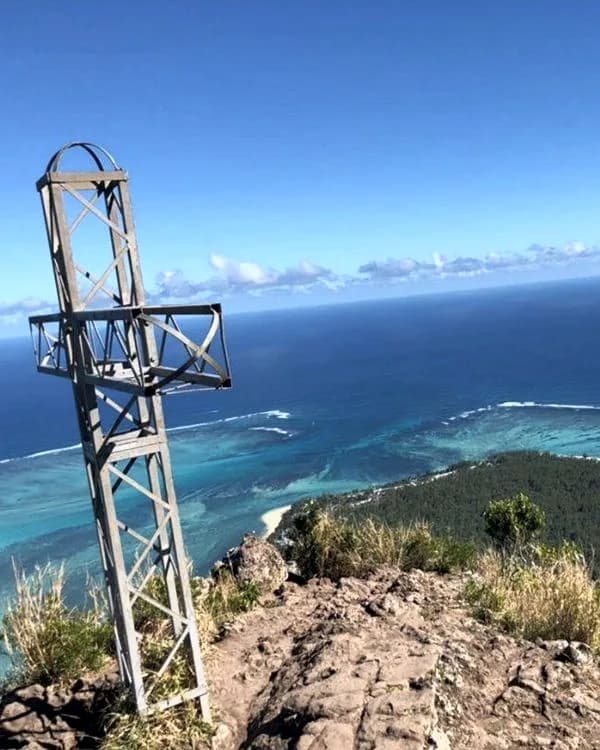
The Mountain Behind The View
Le Morne Brabant is easy to admire before you understand it. From the southwest coast of Mauritius, the mountain rises out of the lagoon like a dark wall of basalt, edged by reef, beach, village roads, and open sky. It is one of the island's most photographed places.
But Le Morne is not only scenery. Its cliffs, ravines, wooded slopes, caves, and high plateau are part of a cultural landscape shaped by slavery and resistance. For many Mauritians, especially descendants of enslaved people, the mountain is a place of memory before it is a viewpoint.
The story of Le Morne asks visitors to hold two truths at once: the place is beautiful, and the beauty is inseparable from pain, survival, courage, and the long search for freedom.
Mauritius And The Eastern Slave Trade
Mauritius had no Indigenous population before colonization. The island's modern population was formed by people who arrived by force, by labor systems, by trade, by migration, and by choice. During the Dutch, French, and British periods, the island became tied to violent systems of colonial extraction.
Enslaved people were brought to Mauritius from several regions, including the African mainland, Madagascar, India, and Southeast Asia. They were made to work under brutal conditions, especially in plantation and domestic labor systems that tried to control not only bodies, but language, culture, movement, family life, and spiritual practice.
Against that system, some people escaped. In the Indian Ocean world, as in the Caribbean and the Americas, these freedom seekers were often called maroons. Maroonage was not a romantic adventure. It meant hunger, danger, pursuit, punishment, and the constant work of staying hidden.
What Maroonage Meant At Le Morne
UNESCO recognizes Le Morne as an exceptional testimony to maroonage because the mountain was used as a refuge by people escaping slavery. Its natural form mattered. The mountain is isolated, steep, wooded, and difficult to access. The topography creates a fortress-like character.
Oral history, written references, and archaeological traces all help explain why the place became so important. The V-Gap, a narrow and dangerous pass, is remembered as one of the keys to the mountain. Cave shelters and evidence of fire and survival point to people using the summit and upper slopes as places of refuge.
To live there would have required skill, secrecy, cooperation, and nerve. Maroons had to find food and water, watch the approaches, communicate with people below, and move through a landscape that could protect them but also kill them.
Why The Mountain Became A Symbol
Le Morne became larger than one local story because it gathers many layers of meaning into one landscape. It speaks of capture, escape, fear, dignity, sacrifice, and resistance. It also connects Mauritius to the places from which enslaved people were taken: Africa, Madagascar, India, and Southeast Asia.
The mountain's meaning extends beyond the summit. UNESCO notes that the values of the site reach into the foothills and coast, even though the property itself is centered on the mountain. That is important. The cultural landscape includes paths, settlement traces, oral traditions, village memory, the lagoon, the buffer zone, and the communities that keep the story alive.
A visitor who sees only a hike misses the point. Le Morne is not protected because it is photogenic. It is protected because a landscape became a witness.
The Legend Most People Know
The best-known Le Morne legend is usually told like this: after the abolition of slavery, soldiers or messengers climbed the mountain to tell the maroons that they were free. From above, the maroons saw armed men approaching. Believing they were about to be captured and enslaved again, they chose death over captivity and threw themselves from the cliffs.
This version has been repeated for generations. It is emotionally powerful because it expresses a terrible choice: a return to slavery, or death as the last form of freedom. In that sense, the legend carries a truth even when its exact historical details are debated.
Still, it should not be flattened into a tourist anecdote. If the story is told too quickly, it can turn real people into symbols and reduce a long history of violence, survival, family memory, and resistance to one dramatic scene.
A More Difficult Version
A second version challenges the usual mass-suicide telling. In this interpretation, the tragedy remembered at Le Morne was not a misunderstanding after abolition. It was a massacre, or at least an act of violent pursuit in which maroons were killed, forced to jump, or pushed into death by people who wanted to reassert control.
Anneloes Smitsman's essay on the Maroon legend gives this version careful attention. Drawing on interviews and advocacy work with maroon and slave descendants from Le Morne, Cotteau Raffin, La Gaulette, and the surrounding area, the essay argues that the memory preserved by local descendants is darker than the simplified public version.
The difference matters. A mass-suicide story can be heard as a story of fear and tragic misunderstanding. A massacre story centers resistance, betrayal, coercion, and the violence of slaveholding power after formal abolition. For descendants, those are not minor details. They change what is inherited.
Why The Versions Conflict
The conflict between the two versions is not only about one day on the mountain. It is about who gets to tell history, what counts as evidence, and how oral memory is treated when it challenges cleaner public narratives.
Official heritage language confirms the mountain's role as a refuge and symbol of maroon resistance. It also leaves room for oral traditions, shared memories, and intangible heritage. That matters because enslaved and formerly enslaved communities were often denied the power to write the archive in their own names.
The safest honest position is not to pretend that every detail is settled. It is to say what is well supported, name what is contested, and avoid using uncertainty as an excuse to soften the violence of slavery.
Trou Chenille And Living Memory
The history of Le Morne is not held only on the summit. Trou Chenille, Le Morne village, old settlement areas, oral testimony, sega traditions, artisanal practices, fishing knowledge, traditional medicine, memorial sites, and family histories all belong to the cultural landscape.
The Le Morne Heritage Trust Fund presents Trou Chenille as part of the visitor experience because it helps connect the mountain to daily life, not only to monumental history. This is important. Heritage is not only what happened long ago. It is also how descendants remember, teach, mourn, protect, and reinterpret the place now.
That is why Le Morne should never be understood as an empty natural attraction. It is a living landscape, and living landscapes have neighbors, descendants, duties, and unresolved questions.
The UNESCO Recognition
Le Morne Cultural Landscape was inscribed on the UNESCO World Heritage List in 2008 under cultural criteria (iii) and (vi), with a minor boundary modification in 2011. UNESCO identifies the site as an exceptional testimony to maroonage and resistance to slavery.
The listing recognizes physical and oral evidence: the mountain as a fortress, the shelters used by escaped slaves, the dramatic form of the landscape, and the longevity of oral traditions associated with the maroons.
This recognition did not make the mountain sacred. It was already sacred in memory. What UNESCO did was give international language and protection to a heritage value that local communities, researchers, activists, and cultural workers had fought to defend.
Access, Protection, And The Heritage Trail
Public access to the mountain and heritage trails has its own modern history. Official Le Morne Heritage Trust Fund material notes that access to Le Morne Brabant Mountain opened in July 2016, years after the UNESCO inscription.
That delay matters because access is symbolic. A heritage trail is not just a route to a viewpoint. At Le Morne, the connection between base, slopes, caves, plateau, and summit helps visitors understand how the mountain worked as refuge and memory site.
Protection also requires restraint. The core zone is managed with a low-intervention approach. Visitors are expected to stay on designated trails, respect official access rules, avoid damaging vegetation, leave archaeological objects untouched, and treat memorial spaces with quiet care.
Nature Is Part Of The Story
The mountain's biodiversity is not separate from its heritage. The same cliffs and slopes that helped create a place of refuge also hold rare plants and sensitive habitats. Official material notes endemic and indigenous plant life, including species closely associated with Le Morne.
The site is also connected visually and ecologically to the lagoon and reef. UNESCO's integrity language points beyond the mountain alone, reminding planners and visitors that the foothills, coast, and buffer zone all shape the meaning of the place.
For hikers, this means that respect is practical. Do not pick plants. Do not carve names into rock or trees. Do not leave litter. Do not treat the upper mountain like an obstacle course. The landscape is both fragile and historic.
How To Tell The Legend Responsibly
A responsible telling of the Le Morne legend should avoid two mistakes. The first is pretending the common legend is simple confirmed fact. The second is dismissing oral memory because it is uncomfortable, contested, or difficult to verify in the same way as colonial records.
The better approach is to tell the story in layers. First, Le Morne was used as a refuge by maroons escaping slavery. Second, the mountain became a powerful symbol of freedom, suffering, and sacrifice. Third, the famous death legend exists in more than one version. Fourth, descendants and heritage advocates have challenged versions that present the tragedy only as mass suicide.
That layered telling is more honest and more respectful. It allows the mountain to remain complex, and it keeps the people at the center of the story from being reduced to a single ending.
How To Visit With Respect
Before you hike, read enough history to understand where you are going. If you book a guide, choose someone who can explain the cultural landscape as well as the route. A guide who only sells the summit misses half the mountain.
On the trail, keep noise low, stay on the official path, follow signs, do not go beyond the permitted endpoint, and do not take or move objects. Around memorials and village heritage spaces, behave as you would in a cemetery or sacred site: with quiet attention.
Respect does not require theatrical sadness. It requires accuracy, humility, and care. Le Morne can still be a beautiful day in Mauritius. The point is to let the beauty deepen your attention rather than erase what happened there.
What Le Morne Asks Of Us Now
The Maroon legend of Le Morne is not only about the past. It asks how societies remember violence, who is believed, whose grief is made public, and how a landscape can become a witness when written records are incomplete or unjust.
For Mauritius, Le Morne is a place where national beauty and national wound meet. For visitors, it is an invitation to move beyond the postcard and see a mountain shaped by people who refused to let enslavement define the whole of their lives.
That is the heart of the legend: not death, but the insistence on freedom. Whether one hears the story through the official mass-suicide version, the contested massacre account, or the wider UNESCO history of maroonage, Le Morne remains a mountain of resistance.
Frequently Asked Questions
Was Le Morne really used by maroons?
Yes. UNESCO identifies Le Morne as a site associated with maroon refuge and resistance, supported by the mountain landscape, oral traditions, and evidence connected to shelter and survival.
What is the Maroon legend of Le Morne?
The best-known legend says maroons on the mountain chose death over recapture after seeing men approach the summit. A contested oral-history account argues the event should be understood as massacre rather than mass suicide.
Is the massacre version official?
No. This page presents the massacre version as an important interpretive and oral-history account associated with descendant testimony and advocacy. It is included alongside official UNESCO and Le Morne Heritage Trust Fund sources.
Why is Le Morne a UNESCO World Heritage Site?
Le Morne is listed because it is an exceptional cultural landscape connected to maroonage, resistance to slavery, oral traditions, suffering, sacrifice, and the fight for freedom.
What is the V-Gap?
The V-Gap is a narrow, difficult pass associated with access to the upper mountain. It appears in heritage interpretation as part of the mountain's fortress-like character and maroon refuge story.
Why does Trou Chenille matter?
Trou Chenille helps connect the mountain to village memory, descendant history, cultural practices, and the living heritage around Le Morne rather than treating the summit as the whole story.
Can I hike Le Morne as a normal tourist attraction?
You can hike the official trail when access and conditions allow, but the mountain should be treated as a cultural and memorial landscape, not only as a scenic climb.
How should visitors behave at Le Morne?
Keep noise low, stay on designated trails, do not move objects, do not climb on memorials, do not leave litter, and remember that the mountain is a sacred site for memory as well as a scenic place.
Understand the UNESCO listing
The UNESCO page explains why Le Morne is protected as a cultural landscape, not just as a mountain.